
Russian Lips Sydney: Before & After Preparation, Vertical Technique & 14-Day Timeline
A clinician-reviewed anatomical guide to the Russian lip technique in Sydney: vertical vermilion vector schematics, flat side-profile alignment on Ricketts’ E-line, suitability screening for virgin vs previously treated lips, and what to expect before and across your 14-day recovery.
What Is the Russian Lip Technique? Anatomical Vectoring Explained
Patients enquiring about Russian lips in Sydney are typically referring to a specific vertical vectoring aesthetic inspired by classical heart-shaped vermilion proportions. Unlike conventional horizontal lip approaches that distribute volume across the length and anterior border of the lip, the Russian lip technique focuses on supporting vertical height through the central Cupid’s bow and lower-lip tubercles while keeping the side profile flat.
At Mapp Aesthetics across Miranda (Sutherland Shire) and Outlet Village, Warwick Farm (South-West Sydney), our registered clinicians assess every Russian lip enquiry against your individual craniofacial anatomy rather than applying a one-size-fits-all template. We measure philtrum column length, upper-to-lower lip ratio, dental occlusion, orbicularis oris muscle tension when smiling, and sagittal profile balance along Ricketts’ E-line from the nasal tip to the chin.
Strict anatomical suitability is essential for predictable vertical definition. Because vertical micro-pillars rely on intact internal vermilion compartments and a crisp white-roll boundary, the Russian lip aesthetic is primarily suited to untreated ("virgin") lip tissue or lips that have undergone a dedicated review and full 14-day tissue reset prior to fresh planning.
Anatomical Vectoring & 14-Day Integration Diagrams
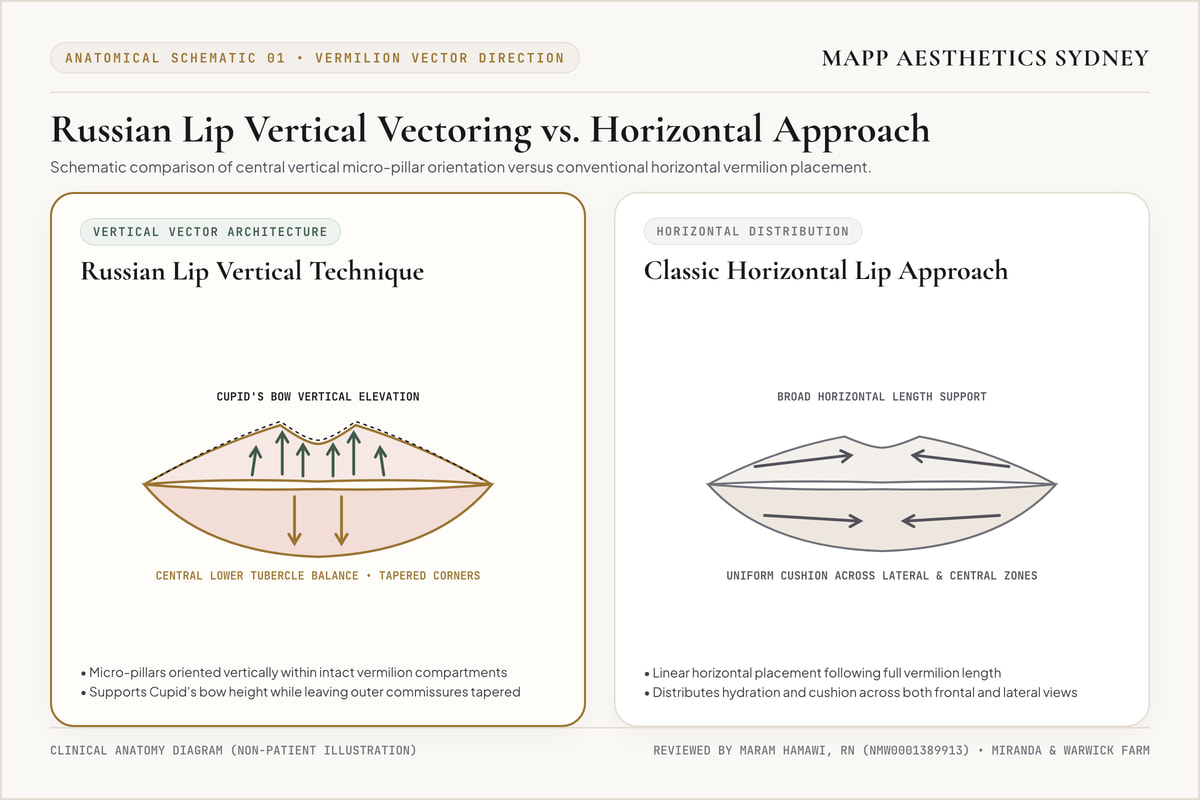
How central vertical micro-pillars elevate the Cupid’s bow and balance central lower tubercles while keeping lateral corners tapered.
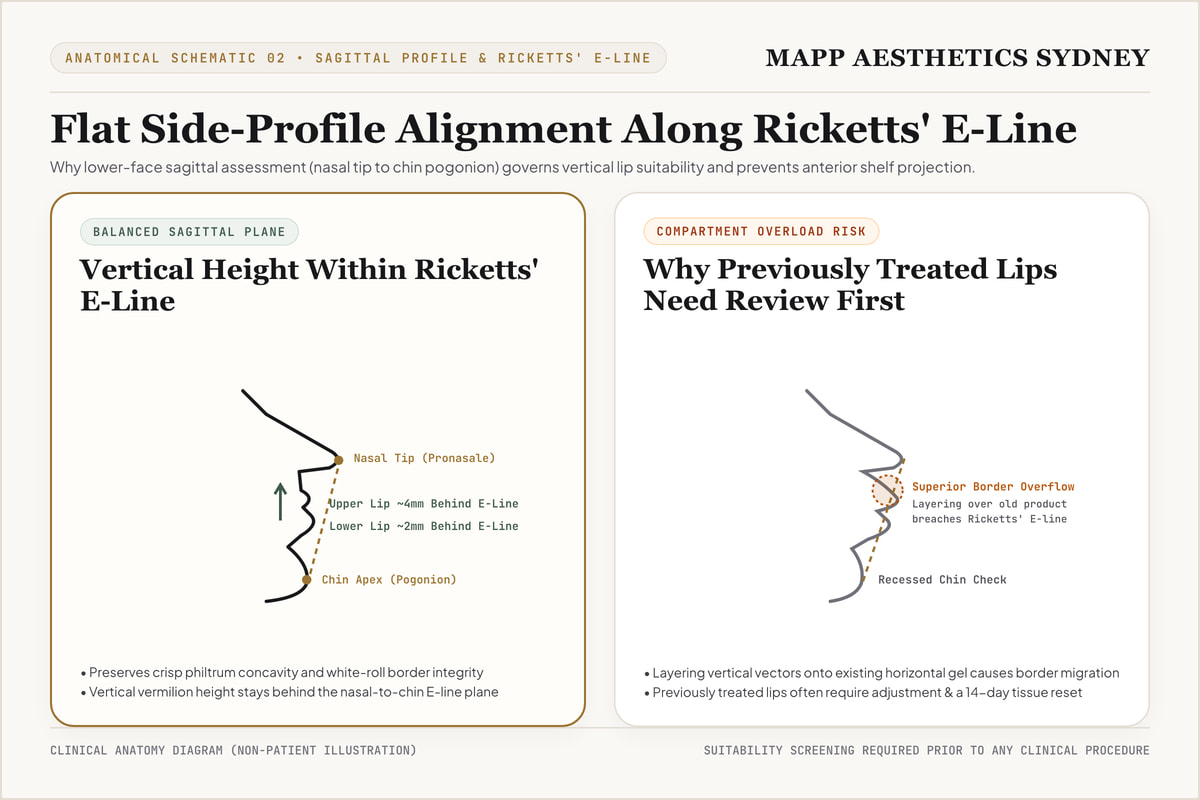
Sagittal profile evaluation from nasal tip to chin apex, illustrating why previously treated lips require border review before vertical planning.
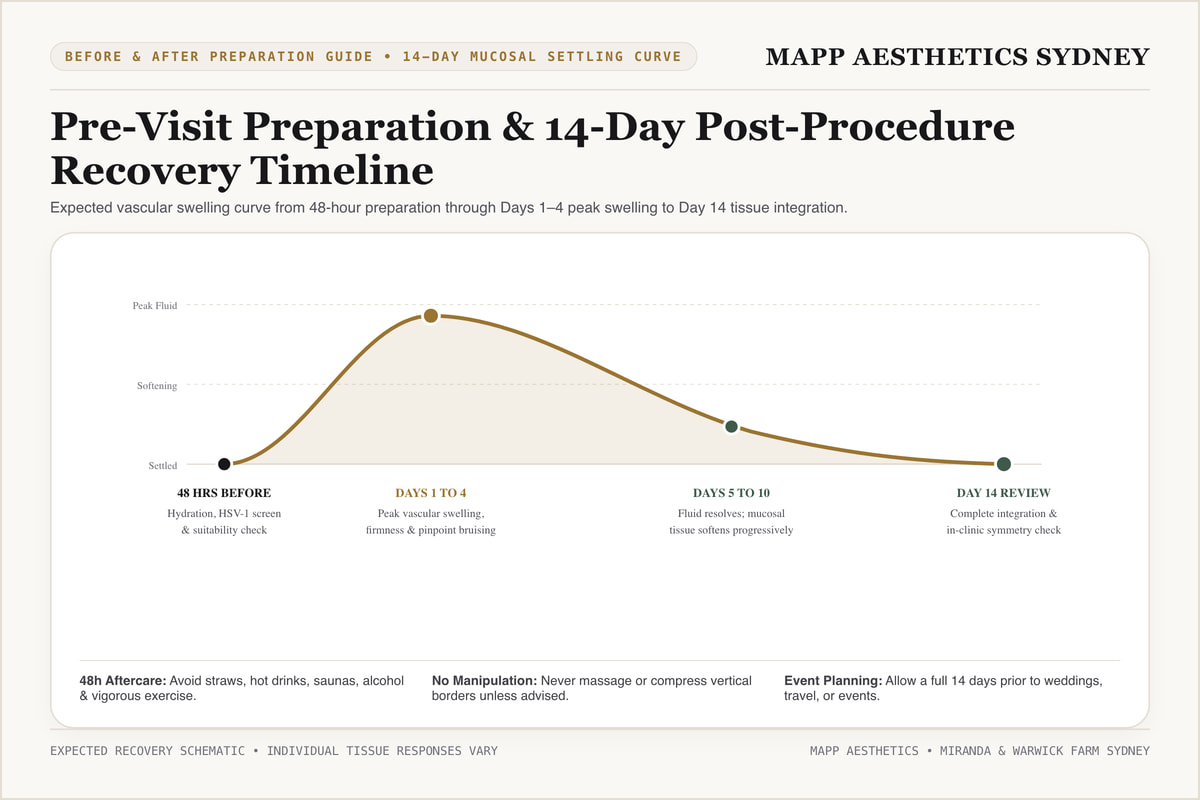
Expected vascular swelling progression from 48-hour preparation through Days 1–4 peak swelling to Day 14 clinical symmetry review.
Russian Lip Technique vs Classic Horizontal Lip Proportion
| Anatomical Factor | Russian Lip Vertical Technique | Classic Horizontal Lip Approach |
|---|---|---|
| Primary Vector Direction | Vertical micro-vectors oriented from the vermilion base toward the Cupid’s bow peaks and central lower tubercles. | Horizontal placement following the native length and mucosal contour of the upper and lower vermilion. |
| Side-Profile Projection (Ricketts’ E-Line) | Prioritises a flat sagittal side profile with vertical height rather than forward projection. | Supports balanced gentle fullness across both frontal and sagittal profile views. |
| Baseline Tissue Requirement | Requires crisp, unmigrated borders; previously treated lips frequently require review and reset first. | Adaptable across both untreated lips and well-integrated maintenance plans within compartment capacity. |
| Typical Swelling & Settling Window | Slightly more pronounced Days 1 to 4 swelling due to precision vertical vectoring; settles by Day 14. | Peak vascular swelling over 48 to 72 hours, softening progressively through Days 5 to 14. |
Pre-Visit & 14-Day Post-Procedure Timeline
| Recovery Stage | Clinical Milestone | What to Expect |
|---|---|---|
| Suitability Screening | Virgin Lip Tissue vs Previously Treated Lips | The Russian lip technique requires crisp, unmigrated vermilion borders and intact mucosal compartments. If you have residual product from earlier lip procedures performed elsewhere, our clinicians will discuss whether a Cosmetic Review & Adjustment step followed by a 14-day tissue recovery window is required first. |
| Consultation Day | Philtrum Length, Cupid’s Bow & Ricketts’ E-Line Mapping | Your clinician evaluates upper philtrum length, dental support, oral commissure taper, and side-profile alignment at rest and in full animation, collaborating with our prescribing medical practitioner before any clinical procedure proceeds. |
| Days 1 to 4 After | Peak Vascular Swelling Phase | Because Russian lip vectoring involves delicate vertical micro-pillars within the vermilion body, initial swelling, firmness, and pinpoint bruising over the first 3 to 4 days can be slightly more noticeable than light hydration protocols. |
| Days 5 to 10 After | Mucosal Softening & Vertical Border Settling | Fluid swelling subsides substantially as tissue integrates smoothly with your native lip mucosa. Temporary minor unevenness or central firmness softens progressively during this phase. |
| Day 14 Review | Crisp Cupid’s Bow & Flat Side-Profile Review | By Day 14, vertical support settles into defined Cupid’s bow peaks and balanced central lower-lip tubercles while keeping the side profile flat against Ricketts’ E-line, verified at your scheduled 2-week clinical review. |
Virgin Lip Tissue vs Previously Treated Lips
The Russian lip technique requires crisp, unmigrated vermilion borders and intact mucosal compartments. If you have residual product from earlier lip procedures performed elsewhere, our clinicians will discuss whether a Cosmetic Review & Adjustment step followed by a 14-day tissue recovery window is required first.
Philtrum Length, Cupid’s Bow & Ricketts’ E-Line Mapping
Your clinician evaluates upper philtrum length, dental support, oral commissure taper, and side-profile alignment at rest and in full animation, collaborating with our prescribing medical practitioner before any clinical procedure proceeds.
Peak Vascular Swelling Phase
Because Russian lip vectoring involves delicate vertical micro-pillars within the vermilion body, initial swelling, firmness, and pinpoint bruising over the first 3 to 4 days can be slightly more noticeable than light hydration protocols.
Mucosal Softening & Vertical Border Settling
Fluid swelling subsides substantially as tissue integrates smoothly with your native lip mucosa. Temporary minor unevenness or central firmness softens progressively during this phase.
Crisp Cupid’s Bow & Flat Side-Profile Review
By Day 14, vertical support settles into defined Cupid’s bow peaks and balanced central lower-lip tubercles while keeping the side profile flat against Ricketts’ E-line, verified at your scheduled 2-week clinical review.
Anatomical Proportions Assessed
- Vertical height from the wet-dry mucosal junction to the Cupid’s bow peaks
- Flat sagittal side profile along Ricketts’ E-line (avoiding forward projection)
- Central lower-lip tubercles balanced with tapered lateral oral commissures
- Philtrum column length and upper-lip inversion dynamics when smiling
- Intact white-roll border integrity without historical superior migration
Essential Post-Care Guidelines
- Allow a full 14 days before assessing final Russian lip vertical proportion, particularly ahead of major events.
- Avoid straws, smoking, vaping, hot beverages, alcohol, and saunas for 48 hours post-appointment.
- Do not massage, press, or compress the vertical vermilion border unless specifically instructed by your clinician.
- Inform your practitioner prior to your visit if you have any history of cold sores (HSV-1) so preventive care can be arranged.
Frequently Asked Questions
Can I have the Russian lip technique if I already have previous lip product in my lips?
Usually not in the same sitting. Layering vertical Russian lip vectors over existing horizontal or migrated lip work exceeds anatomical compartment space and increases border migration risk. During your consultation in Miranda or Warwick Farm, your clinician will palpate and inspect the tissue to advise whether resetting the lips and waiting 14 days is the most appropriate pathway.
How is the Russian lip aesthetic different from standard lip proportion treatments?
Traditional lip proportion approaches distribute support horizontally across the lip body for overall cushion and hydration. The Russian lip technique concentrates on vertical height through the central Cupid’s bow and lower-lip tubercles while maintaining a flat side profile from nose to chin.
Is everyone anatomically suited to Russian lips?
No. Patients with very short philtrum lengths, tight orbicularis oris muscle tone, scarred vermilion borders, or migrated product from previous treatments may achieve more harmonious facial balance with a tailored anatomical hydration or classic proportion plan. Suitability is always confirmed face-to-face during your consultation.
How long does swelling last after a Russian lip appointment?
Because vertical vectoring requires detailed placement across the central vermilion, peak vascular swelling lasts 48 to 96 hours, settles substantially between Days 5 and 10, and reaches complete integration at your Day 14 clinical review.